Scoring Over $20K on One Pallet of a 3PL Truckload
SCORING OVER $20K!!! ON ONLY ONE PALLET OF MY 3PL TRUCKLOAD!
Guys, this is why liquidation will mess with your head.
One pallet.
24 pallets on the load.
About $4,000 just to ship it from New Jersey.
And off one single pallet, we started pulling enough car parts and margin to make you stop and say, hold up… this thing might be a monster.
That’s the game.
You buy a load nobody else wants to figure out.
You bust it open.
You do the work.
And sometimes one pallet punches you in the face with profit.
This one did.
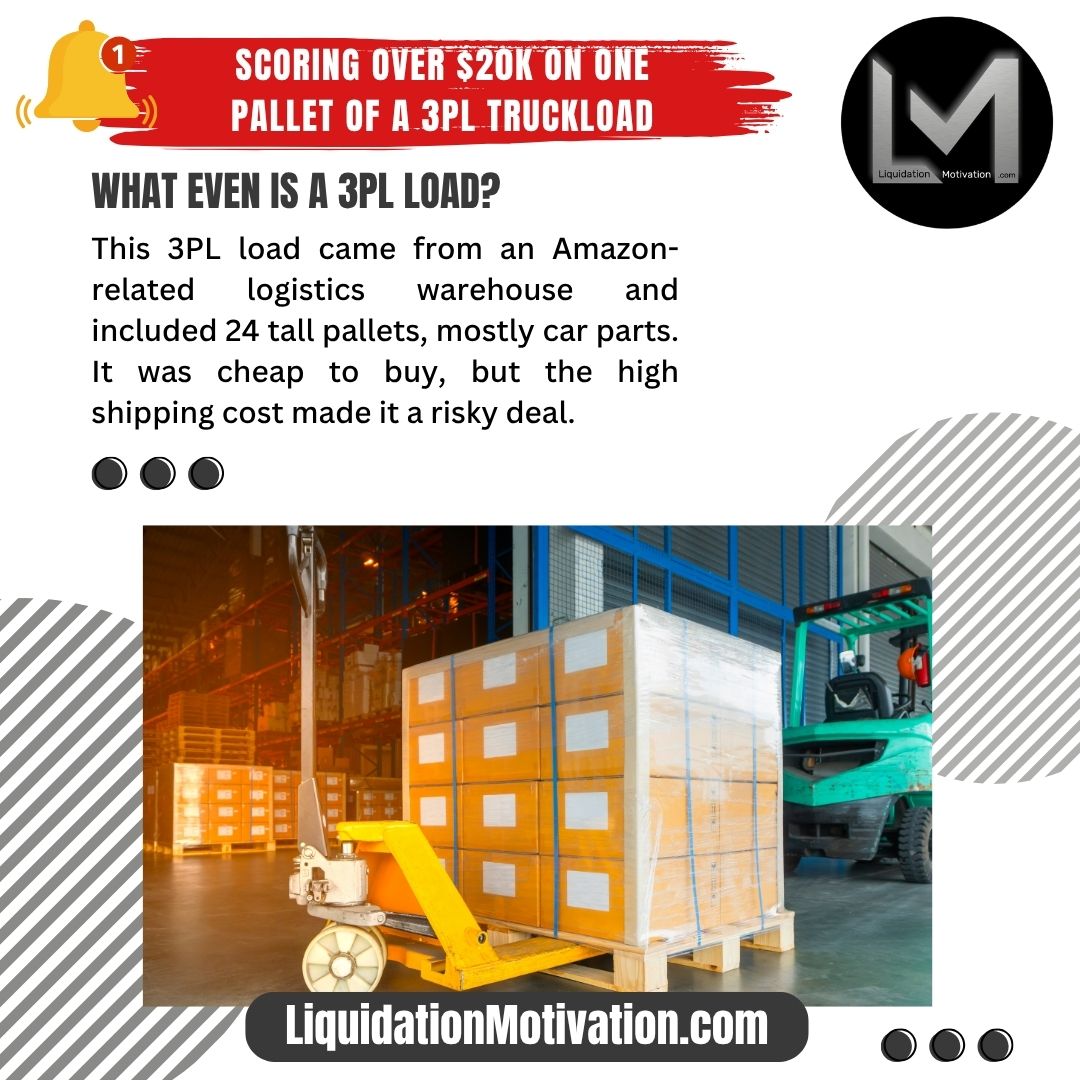
First — What Even Is a 3PL Load?
A lot of people hear “3PL” and have no clue what that means.
A 3PL is a third-party logistics company. Big Amazon sellers use them to store inventory, feed product into Amazon, and handle the returns side of the business. So when stuff gets kicked back, rejected, returned, changed-mind, wrong fit, wrong part, wrong order — it piles up there.
That’s where this load came from.
This one was:
24 pallets
stacked 5, 6, 7 feet tall
heavy on car parts
and cheap enough that I had to take the shot
The risk?
Shipping alone was about $4,000, which was almost as much as buying the load. That means if the product sucks, you didn’t just buy a bad load — you bought an expensive lesson.
er touched
That’s the game.
The First Pallet Started Swinging Early
Guys, we didn’t even have to get deep into the pallet before the thing started talking back.
Right out of the gate we pulled:
a ThinkScanner OBD scanner at about $451
a transmission valve body around $1,000
a BMW steering wheel with airbag around $900 to $1,000
a custom chrome exhaust around $1,300
a pair of scanned items that came back around $500 each
a torque converter around $600
another valve body around $700
air ride / suspension-type parts in the $400 range
a crossbow setup that looked like roughly $1,000 in one box
plus cat parts, wiring, boots, sensors, shock parts, steering parts, and all kinds of weird automotive money pieces
And that was one pallet.
Not the whole load.
One pallet.
That’s why I say all the time — stop judging a load by the first ugly box.
This Is Why 3PL Loads Can Be Gold
Most people don’t want to deal with weird inventory.
They want it easy.
They want to be obvious.
They want “open box, see iPhone, sell iPhone.”
That’s not how you build a real business.
This pallet had:
car electronics
transmission parts
sensors
steering parts
trim
catalytic converter-type pieces
suspension parts
apparel
boots
random junk
and some absolute home runs mixed in
That’s liquidation.
Messy.
Confusing.
Profitable.
If you know where to sell it.
And that’s the real separator.
Rapid-Fire Value Riffs
Let’s do the math, guys.
We’re not talking fantasy numbers. We’re talking rough liquidation math from what came off that one pallet.
Here’s a sample of what was called out right there during the unboxing:
OBD scanner: $451
valve body: $1,000
BMW steering wheel: $900–$1,000
chrome exhaust: $1,300
two scanned items: $500 each
torque converter: $600
another valve body: $700
suspension / pump part: $400
crossbow box: roughly $1,000
steering stabilizer: $185
coil packs: around $150
fishing waders: around $140
You start adding that up and you’re already blowing past $7,000, $8,000, $9,000 fast — and that’s before counting all the smaller car parts, trim pieces, harnesses, carbon fiber pieces, catalytic converter parts, boots, sensors, and all the stuff not fully priced on camera.
That’s why Tom’s take was that the first pallet had around $10,000+ in it — and with the deeper count, the title claim of over $20K on one pallet makes the whole point loud and clear:
One pallet can carry the whole load.
That’s the game.
Not every item has to be a banger.
You just need enough bangers to pay for the sins.
The Real Skill Is Not Opening Boxes
Guys, beginners always think the skill is unboxing.
Nope.
The skill is:
identifying value fast
knowing what’s trash
knowing what’s long-tail
knowing what gets listed today
and knowing what belongs on eBay versus what belongs in a bulk lot
This pallet was screaming eBay. Tom even said it straight — a lot of this is long-tail car stuff that can sit on eBay until the right buyer shows up.
That matters.
Because a lot of people hate car parts.
They don’t understand them.
They don’t want to research them.
They don’t want to deal with fitment.
They don’t want to test them.
They don’t want to photograph them.
That’s exactly why the opportunity exists.
Where People Get Burned on Loads Like This
Now let’s not act like this is easy money.
This kind of load will burn the hell out of lazy operators.
Why?
Because some buyers return the bad part and keep the good one.
Some boxes are mislabeled.
Some parts are used.
Some stuff is wrong fit.
Some stuff is dead inventory.
And some of it is just plain weird.
That means you need a system.
Not hope.
Not vibes.
Not “I’ll figure it out later.”
You need:
somebody who understands parts
a process to test or inspect
good photos
part number research
eBay discipline
space to sort
patience
Without that, this load becomes chaos.
With that, this load becomes margin.
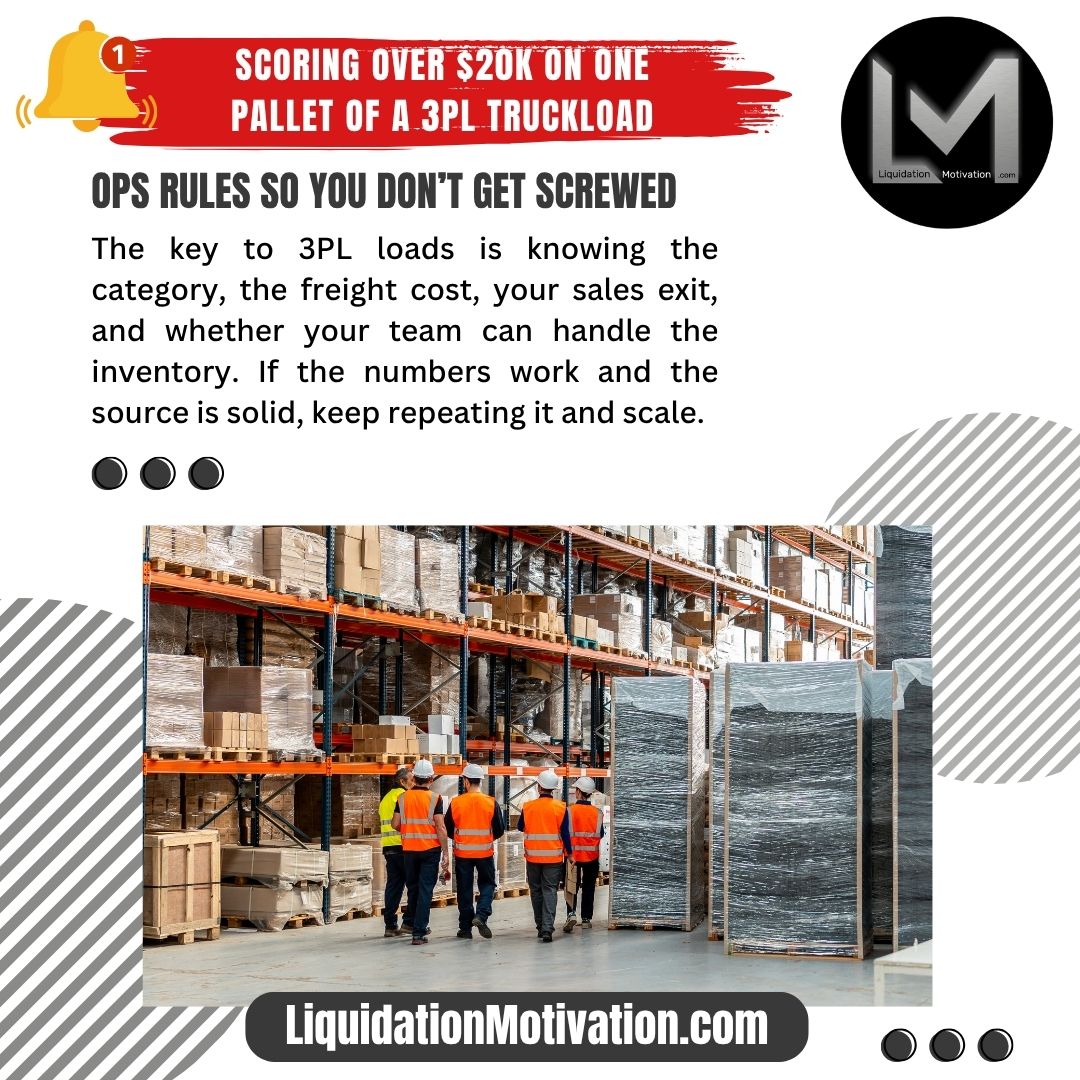
Ops Rules So You Don’t Get Screwed
Here’s the real play if you’re hunting 3PL loads.
1. Ask what category dominates the load
In this case, they said car parts, and they weren’t lying. That helped frame the whole opportunity.
2. Ask where the load is coming from
If it’s coming from somewhere far away, freight can murder the deal. Tom said it straight — shipping from New Jersey was about $4,000.
3. Know your exit before you buy
If you don’t sell on eBay, a load like this can whip your ass. This is not “throw it in the bin store and pray” inventory.
4. Don’t confuse return status with junk
A lot of boxes said things like changed mind, didn’t want it, or regular return reasons. That matters. Not every return is bad product.
5. Be honest about your team
If you don’t have a Mingo-type car guy around you, some of this product is going to sit there while you stare at it like an idiot.
6. Avoid the scramble game
If you find a source like this and it works, lock it in. Tom was already talking about getting two loads a week if the numbers keep making sense. That’s how you scale.
Why This Matters for a Pallet House
This is the exact reason I’m always preaching about building a real pallet house operation.
You need room.
You need systems.
You need labor.
You need shipping lanes.
You need multiple sales channels.
And you need to know how to spot loads other people are scared to touch.
A little warehouse with no structure gets crushed by a load like this.
A real pallet house?
This is where a pallet house prints money.
Because one pallet might go:
eBay
Facebook Marketplace
auction
wholesale lot
mechanic bulk buy
local parts flipper
export buyer
That’s how you win.
Volume over value does not mean “ignore profit.”
It means don’t sit around babysitting one pretty item when the whole damn load is waiting to move.
The Bigger Lesson Here
Guys, the biggest lesson is not that this one pallet was loaded.
The biggest lesson is this:
Opportunity lives inside confusing inventory.
Everybody wants the easy load.
Everybody wants brand-new iPhones.
Everybody wants sealed electronics.
Everybody wants obvious value.
But the real operators make money where other people hesitate.
That’s what this pallet was.
Messy.
Heavy.
Random.
Car-part weird.
And full of margin.
So was this 3PL load worth buying?
Guys, if one pallet is already spitting out this kind of value, this is the kind of deal that can change your whole month.
Maybe your whole quarter.
Not because every pallet is perfect.
Not because every box is gold.
But because one strong pallet can carry a lot of ugly.
That’s liquidation.
You buy right.
You process fast.
You list smart.
You avoid the scramble game.
And you save your damn money by buying the hard stuff other people are too scared to touch.
That’s how you build a real business.
Want more liquidation breakdowns, truckload strategy, pallet house lessons, and bin store content?
Now go out there and make some money.
home | blog
