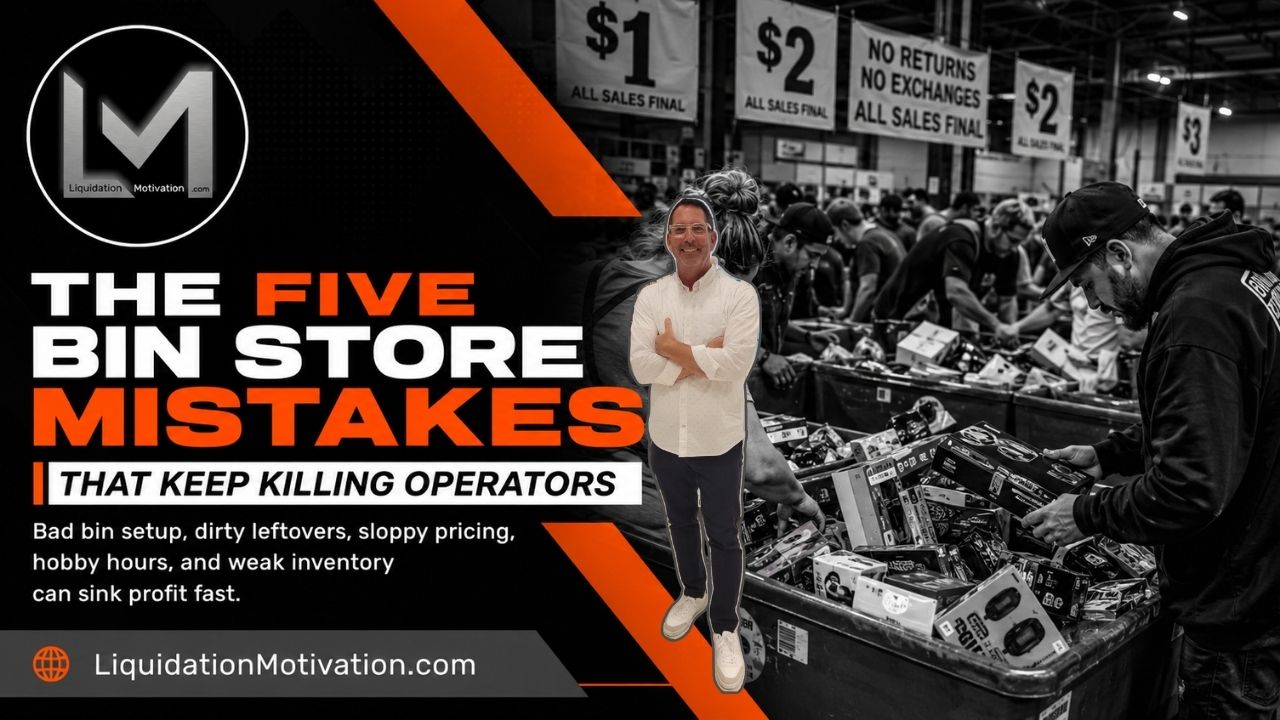
Five Bin Store Mistakes That Kill Profit
A bin store can fail for five boring reasons before the owner admits it: bad bin setup, dirty leftovers, stupid pricing, hobby hours, and weak inventory. Tom lays out a pricing waterfall of $12, $10, $7, $5, $3, $1, and $0.50. He also talks about being open 10:00 to 8:00 most days and how some people buy 10 pallets, open the doors, and think they are in business.
Guys, those numbers matter. The price ladder pulls value out of the week. The hours give working customers time to shop. The 10-pallet example shows the danger of opening before the supply chain is ready.

Stop Organizing the Treasure Hunt
A bin store is supposed to feel like a treasure hunt. That means the value needs to be spread through the bins so customers keep digging.
Tom gives the recipe book example. If hundreds of the same book get stacked in one corner, customers know there are too many. They wait for $3 day, $1 day, or $0.50 day. You trained them not to buy.
When those items are scattered, the customer does not know how many are there. They find one, decide it has value, and buy it because they may not see another one.
Do not make your bins look like a library shelf. Dump the merchandise in. Keep it random. Fill your freaking bins with useful inventory, not neat little displays that tell people to wait.

Leftovers Kill the Next Restock
Another mistake is leaving dead merchandise in the bins at the end of the week.
If customers did not buy it on the cheapest day, do not bury next week’s good product under it. That makes fresh inventory look dirty before shoppers even get to it.
The customer wants new, clean merchandise. They do not want to fight through protein powder, crushed boxes, stale leftovers, and junk that already failed the price ladder.
Bag it and run a $20 bag sale. Box it up. Palletize it and sell it as a reseller lot. Move it through another channel. Throw it away if it truly has no value.
The worst option is keeping it in the bins because you are attached to it. Do not fall in love with your inventory. The bin store floor is not storage.

Crazy Pricing Confuses the Customer
A bin store needs a clean falling price strategy.
Tom’s example is simple: $12, $10, $7, $5, $3, $1, and $0.50. The exact numbers can change by market, but the logic should not.
High-value shoppers come early. Midweek shoppers dig for missed value. Low-price days bring volume buyers, flea market sellers, yard sale people, and resellers.
If your pricing jumps around like $12, $12.75, $5, and $3, customers do not know how to shop you. Worse, you may stop too high and never clear enough weak merchandise before restock.
When the ladder is built right, every day has a customer. The first day gets high recovery. The last days clean the bins and pull value from product that would otherwise sit.
Volume over value matters at the bottom of the week. Marginal items still have value when priced for the right buyer.

Hobby Hours Do Not Pay Retail Rent
If you close at 5:00 every day, you are not serious about retail.
Most customers get off work around that time. If your store closes when they finally have time to shop, you are sending them somewhere else.
Tom talks about being open 10:00 to 8:00 most days, with only a shorter day before reload. The lease does not charge you for five days. It charges you for seven.
A bin store needs the full pricing cycle. Fresh drop days, midweek digging days, low-price days, and cleanout days all matter. If you are closed too often, the waterfall breaks.
This is retail with heavy inventory, messy customers, long hours, and constant restocking. If you do not want that schedule, do not open the store.

Inventory Is the Real Boss
The biggest mistake is opening a bin store without controlling inventory.
Tom says people buy 10 pallets, open the doors, and call themselves bin store owners. Then the next week comes, and they have no dependable supply.
Now they are in the scramble game.
They drive 10 hours, call everybody, buy whatever is available, and pay too much because restock day is coming. That is how panic buying starts. That is how margins get crushed.
Liquidation is an opportunity business. You buy the right loads when the opportunity is there.
If you cannot buy truckloads, you are usually at a disadvantage. Tom says you can pay thousands more per load when you cannot buy at that level. That extra cost usually comes straight out of margin.
A strong bin store blends good and marginal merchandise. The good stuff sells early. The marginal stuff sells later. If you cannot mix categories, control volume, and keep bins full, the model gets weak fast.
Before opening another store, ask one question: can your supply chain feed it every week?
Practical Closing
The bin store business is getting harder. That does not mean it is dead. It means sloppy operators are running out of room.
Keep the bins random. Clear the leftovers. Use a real pricing waterfall. Stay open when customers can shop. Control your inventory before you sign the lease.
And when buyers take pallets from you, make the rule clear: they take the whole pallet and clean up after themselves. If they cannot take their stuff, they cannot come back.
Avoid the scramble game. Build the system before the store needs it.
Learn more at LiquidationMotivation.com.
Now go out there and make some money.
