
Don’t Pass Up Clothing Deals!
Don’t Pass Up Clothing Deals!
Guys, too many people pass on clothing because they think it’s boring, slow, messy, or beneath them.
That’s stupid.
$1 a piece.
40,000 pieces sitting in one deal.
And items selling for $7, $25, even $30 when the niche is right. That is exactly why you do not walk past clothing loads.
That’s money.
Not “maybe” money.
Not “someday” money.
Real margin.
And if you’re serious about liquidation, you better stop acting like clothing doesn’t count just because it doesn’t look sexy on a pallet.

Guys, Clothing Is Where the Money Hides
Here’s the mistake a lot of liquidators make.
They want the obvious home run.
They want the electronics pallet.
They want the Nike shoe pallet.
They want the gold.
They want the easy story.
Meanwhile, the guys actually making money are standing over here saying, “Wait a minute… this load is costing me about a dollar a piece and I can turn around and sell it piece by piece all day long.”
That’s the play.
This transcript laid it out clean:
a clothing deal with 40,000 pieces
patriotic / conservative apparel
hoodies and tees
bought around $1 per piece
and already moving on live platforms for $7 up to $25 or $30 on some items
Guys, that is not a small spread.
That’s why I keep saying: save your damn money on the front end, buy right, then let the margin do the work.
Stop Thinking Like a Shopper. Start Thinking Like an Operator.
A shopper says, “I wouldn’t wear that.”
An operator says, “Will it sell?”
That’s the difference.
The load Tom was talking about was loaded with niche message apparel — patriotic stuff, conservative stuff, slogan tees, hoodies, all brand new and case packed. Whether you personally love it or hate it does not matter one damn bit. 50% of America likes that stuff, and if they like it, they’ll buy it.
That’s business.
Your opinion doesn’t pay the bills.
The market does.
If a piece costs you $1 and sells for $10, you don’t need to write poetry about it.
You need to stack the profit.
Rapid-Fire Value Riffs
Let’s do the real math, guys.
Example 1: Base hit math
If you buy clothing at $1 per piece and sell it for just $7, you’re making $6 gross per item. On 1,000 pieces, that’s $6,000 gross. On 10,000 pieces, that’s $60,000 gross.
Example 2: Better mix math
If hoodies and stronger pieces are hitting $25 to $30, then even if the average across a mixed load lands around $9 to $12, the spread is still nasty in a good way.
Example 3: The full 40,000-piece mindset
At 40,000 pieces bought around $1 each, your load cost is roughly $40,000. Sell even a big chunk of that at strong piece-by-piece pricing, and now you’re talking about a real operation, not garage-sale money.
That’s why I keep hammering this:
volume over value.
Not because value doesn’t matter.
Because when the unit cost is low enough, the volume becomes the weapon.
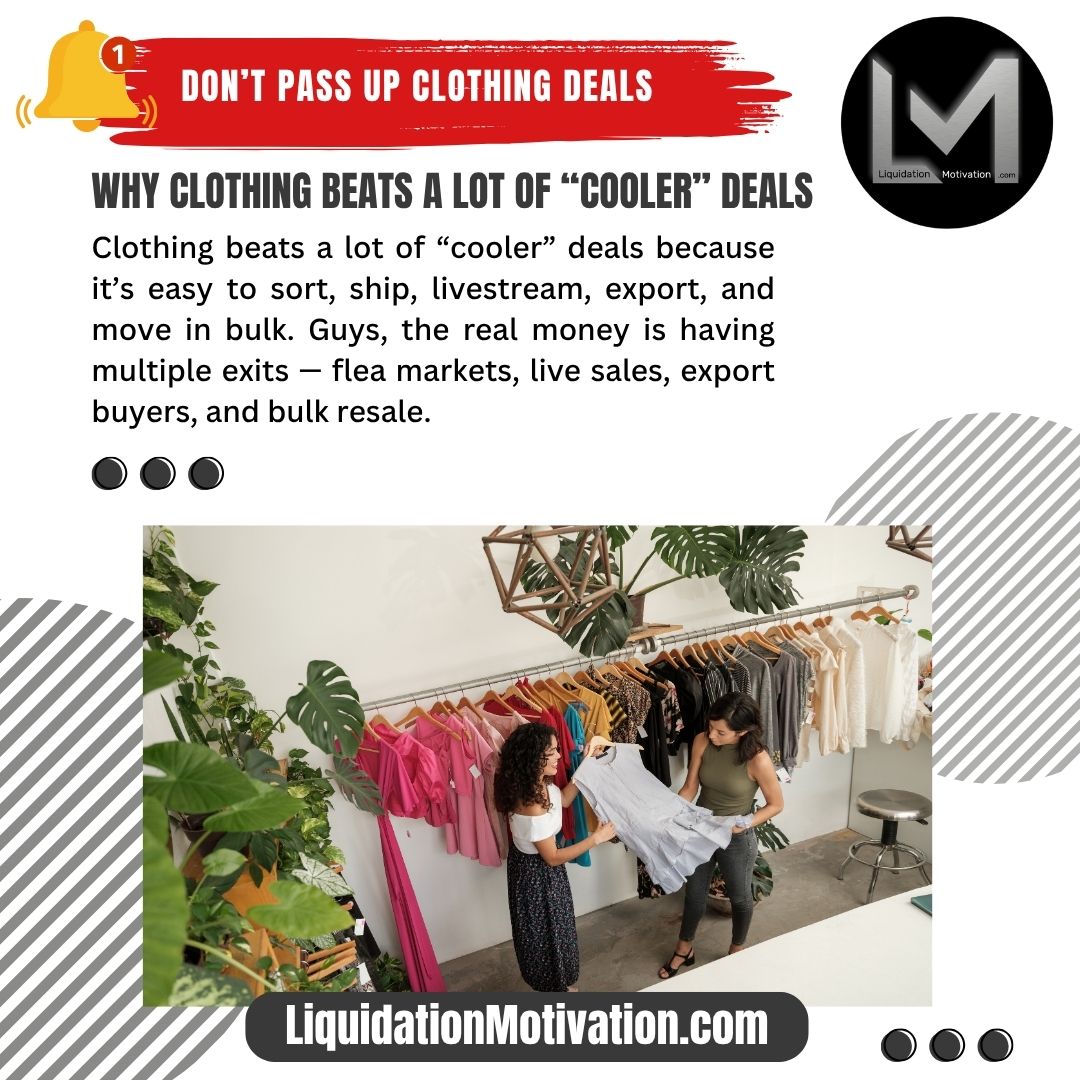
Why Clothing Beats a Lot of “Cooler” Deals
Guys, clothing has some advantages people keep ignoring.
It’s:
easy to stack
easy to sort
easy to piece out
easy to ship
easy to livestream
easy to export
and easy to blow out at flea markets, live sales, or bulk resale
Tom straight up said people are exporting clothing to Mexico, and there are serious buyers out there moving volume if you can find the right lane.
That matters.
Because a lot of liquidators get trapped in one exit.
They buy the load.
They have one way to sell it.
Then they panic.
That’s amateur stuff.
You need multiple exits.
The Bigger Lesson: No Load Is Perfect
One of the best points in the transcript had nothing to do with clothing itself.
It was this:
There is not one load that’s perfect for just one live-selling platform. Everything has to be processed, separated, and pushed into the right channel.
That’s the real business.
Whatnot.
TikTok.
Bin store.
Pallet sales.
Flea market.
Bulk buyer.
Exporter.
Consignment.
Marketplace.
The winners are not the people waiting for the perfect load.
The winners are the ones who know where everything goes.
That’s how you avoid the scramble game.
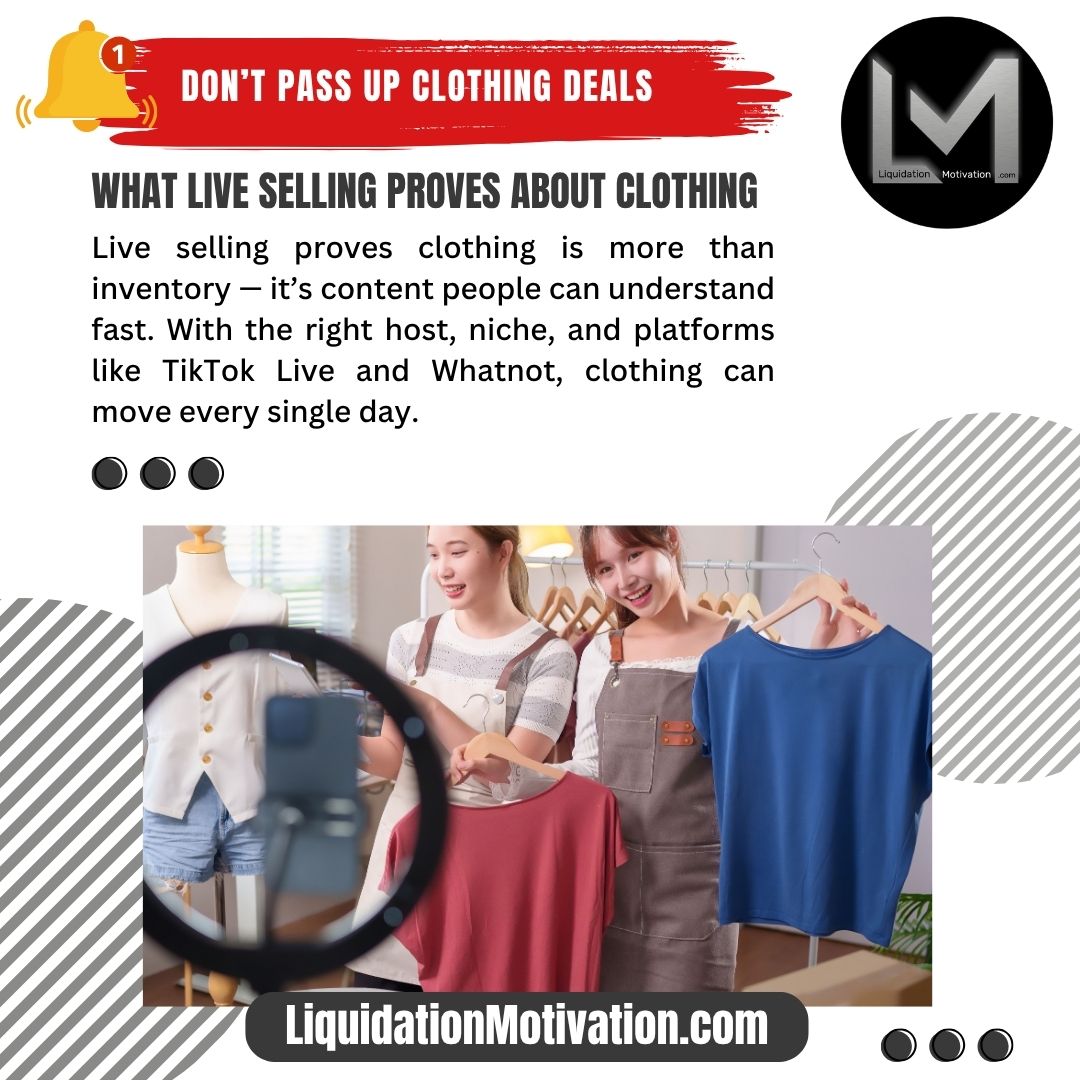
What Live Selling Proves About Clothing
Guys, the transcript also showed the bigger machine behind this.
They’re running:
TikTok live
Whatnot
daily processing
shipping
pickup orders
and separate inventory sorting for each channel
At the time of the transcript:
TikTok had around 500 followers and had already done $2,000 to $3,000 in sales on about 130 items
Whatnot had grown to around 35,000 followers
and they were spending around $100,000 a week bringing in five different kinds of loads to feed the platforms
That should tell you something.
Clothing isn’t just “clothing.”
It’s content.
It’s repeatable inventory.
It’s a category people understand.
It’s fast to show on camera.
And it gives you a clean, easy-to-explain offer.
If you’ve got the right host and the right niche, clothing moves.

Niche Clothing Is Even Better
Now here’s where it gets even more interesting.
This wasn’t just generic apparel.
The transcript showed two strong examples:
1. Patriotic / conservative apparel
Stuff with identity.
Stuff with tribe.
Stuff people buy because it says something about them.
2. Gothic / horror / fandom apparel from Killstar
This came in on consignment and included clothing plus plushies tied to horror and pop-culture niches. They were already testing it and seeing strong response.
That’s the lesson.
Generic is okay. Niche is better.
When people identify with the product, your pricing gets stronger.
They’re not just buying fabric.
They’re buying identity.
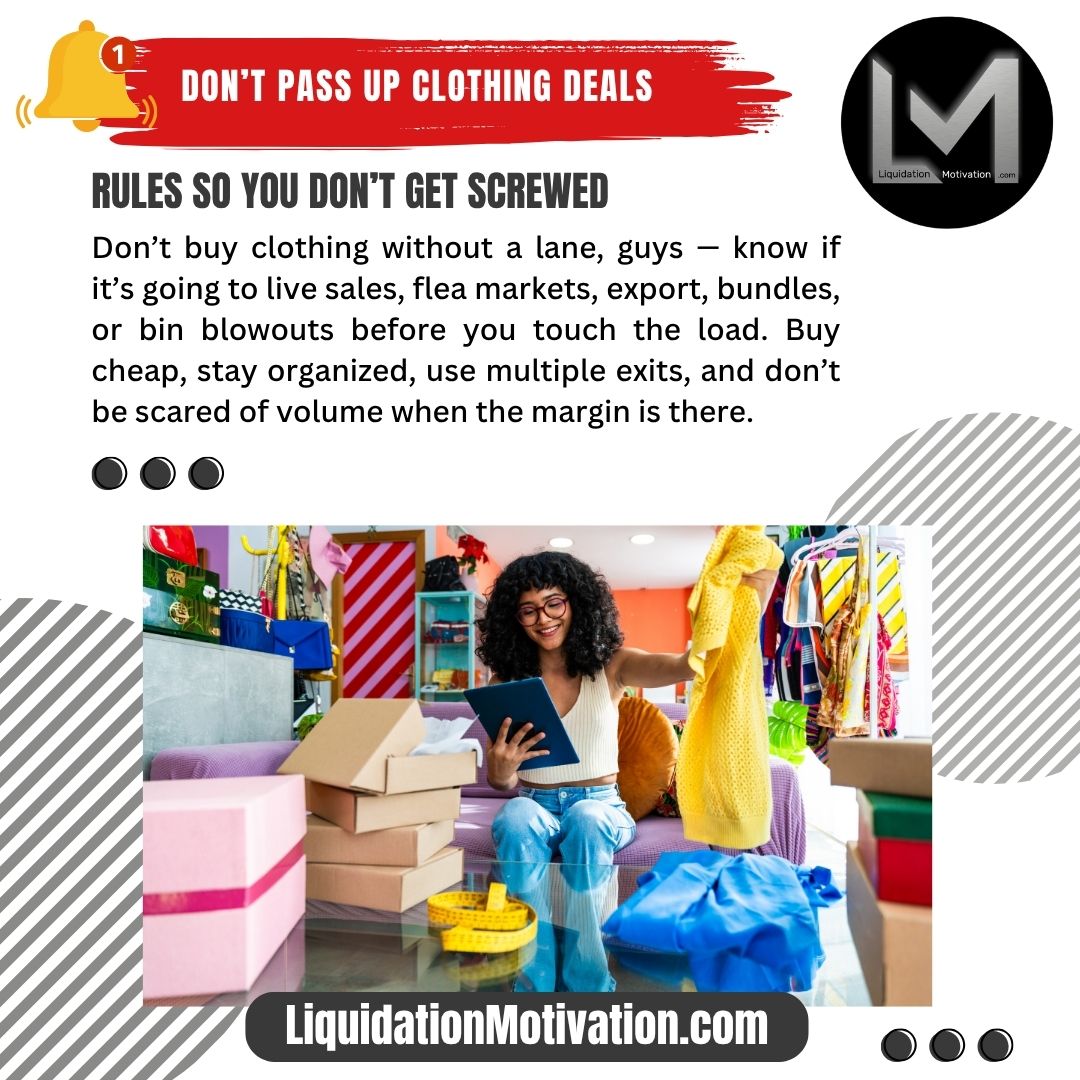
Ops Rules So You Don’t Get Screwed
Here’s how you do clothing the right way.
1. Buy cheap enough to win ugly
If you’re around $1 a piece, you’ve got breathing room. If you’re paying too much up front, you kill the whole deal.
2. Know your lane before you buy
Flea market?
Whatnot?
TikTok?
Export?
Bulk resale?
Don’t buy 40,000 pieces and then ask yourself what the plan is.
3. Don’t judge the message — judge the margin
Who cares if it’s patriotic, gothic, horror, biker, blue-collar, or weird as hell?
If the audience exists, you sell to the audience.
4. Keep it case-packed and organized
When clothing is brand new, sorted, and easy to access, your team moves faster and your live-selling hosts stay productive. That matters.
5. Use multiple exits
Some pieces are for live selling.
Some are for bundle deals.
Some are for bin-style blowouts.
Some go to exporters.
Again: avoid the scramble game.
6. Don’t be scared of volume
If the math works, take the deal.
A lot of people are scared by 40,000 pieces.
Real operators see 40,000 chances to get paid.
Why Most People Still Miss This
Because they’re distracted.
They’d rather chase one “hot” electronics pallet and tell everybody on Facebook that they’re in liquidation.
Guys, liquidation is not about looking cool.
It’s about moving product.
And clothing moves.
Not always the fastest.
Not always the flashiest.
But when you buy it right and sell it piece by piece, the margin can be stupid good.
That’s why you do it.
Final Take
So should you pass up clothing deals?
Hell no.
Not if the buy is right.
Not if the niche is strong.
Not if you’ve got sales channels.
Not if you understand simple math.
A lot of people don’t want to touch clothing. Good.
That leaves more for the guys willing to do the work.
Buy it right.
Sort it right.
Sell it where it makes sense.
Fill your freaking bins when you need to.
Push the better pieces to live selling.
Move the rest in volume.
And save your damn money by staying disciplined on the front end.
That’s how you turn “boring” inventory into real profit.
Now go out there and make some money.
home | blog
