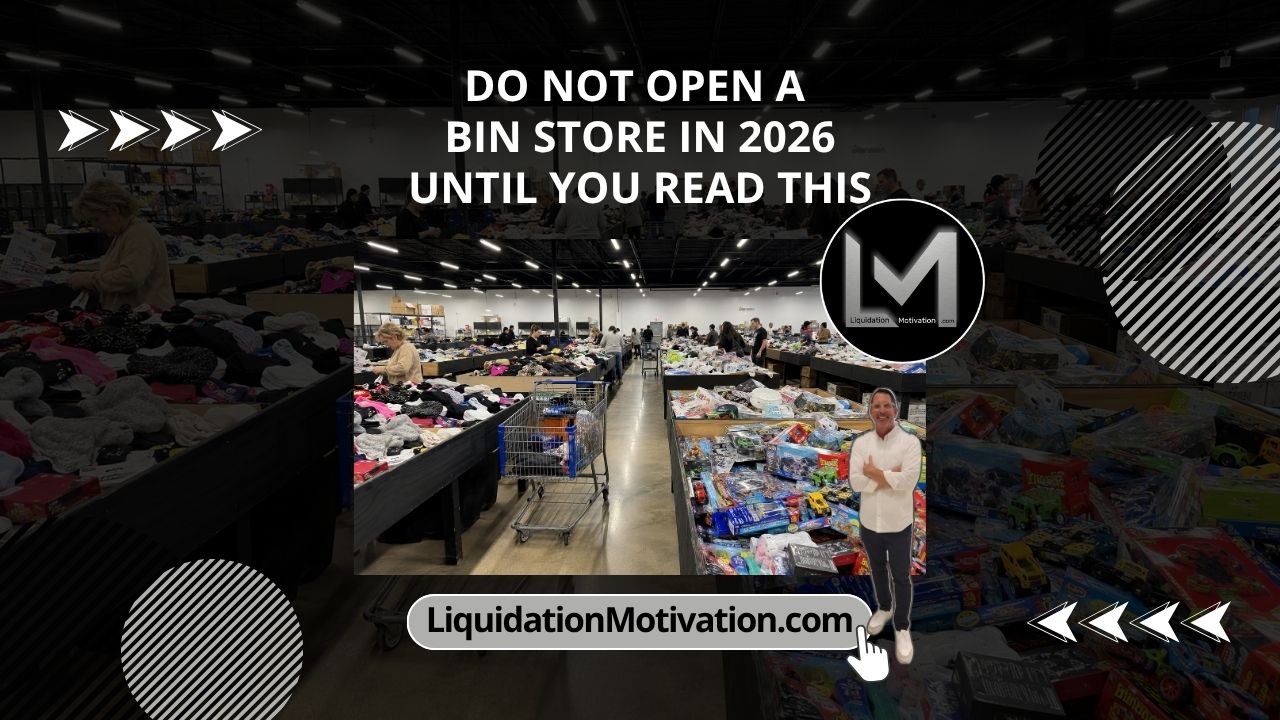
DO NOT OPEN A BIN STORE IN 2026 Until You Read This
DO NOT OPEN A BIN STORE IN 2026 Until You Read This
GDo not open a bin store in 2026 just because you saw somebody dumping Amazon boxes into bins on TikTok.
Guys, listen to me.
5 bin stores. 10 more stores connected. $300,000 to $400,000 a week in buying power. And even with that kind of muscle, Tom said the supply got so tight they went 10 weeks without the core FC and LPN loads that keep bin stores alive.
That should scare you.
Not because the business is dead.
Because the lazy version of this business is dead.
The “open 10 bins, buy 2 pallets, hope people show up” model?
Dead.
The “I’ll just find pallets every week from whoever has them” model?
That is how you end up in the scramble game.
And guys, the scramble game will eat your money, your time, your gas, your labor, and your confidence.
The Big Problem: You Think You’re Opening a Bin Store, But You’re Really Opening a Supply Chain Problem
Everybody wants the fun part.
The grand opening.
The bins full.
The line outside.
The Facebook posts.
The customers digging.
The $12 day excitement.
But nobody wants to talk about the ugly part.
Where is next week’s load coming from?
Where is the week after that coming from?
Can you get enough pieces?
Can you get the right mix?
Can you fill your freaking bins without driving five hours, begging three vendors, and buying leftovers from somebody else?
Because that is where small bin stores get crushed.
They don’t fail because people hate deals.
People love deals.
They fail because the operator cannot keep the store fed.
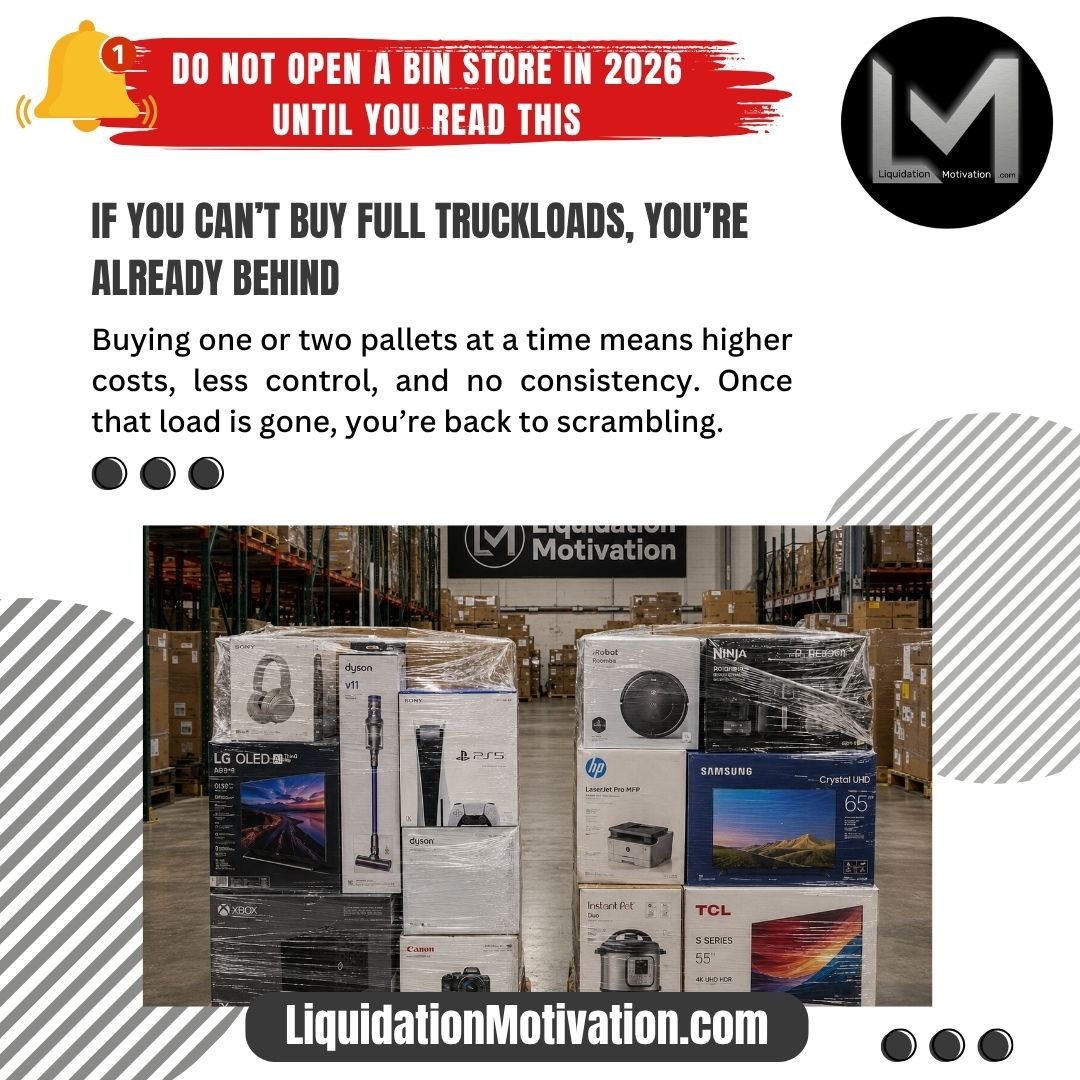
If You Can’t Buy Full Truckloads, You’re Already Behind
Here is the truth nobody wants to hear.
If you are buying one pallet here, two pallets there, three pallets from some random vendor two hours away, you are not in control.
You are depending on somebody else’s leftovers.
Tom gave the example.
He might buy a pallet for $600 and sell it to you for $750.
That is fair. He has freight, warehouse costs, labor, handling, and he needs to make money.
But now your cost is higher before you even touch the product.
Then you dump it in your bins and pray.
Week two comes.
You need more.
You call again.
And guess what?
The load is gone.
Now you’re scrambling.
That is not a business model.
That is panic with a cash register.
Rapid-Fire Value Riffs
Let’s do the math, guys.
FC Load Math
Tom said one FC pallet had around 900 units and the target is around $0.75 to $1.00 per unit.
If you own 900 pieces at $1 each, that is:
900 pieces x $1 = $900 cost
Now let’s say your bin store averages only $3.50 per piece after markdowns.
900 pieces x $3.50 = $3,150 gross sales
That leaves:
$3,150 - $900 = $2,250 gross spread
That is why FC matters.
FC is not always sexy.
It is not always the “wow” product.
But FC fills your lower-dollar days.
That is where the volume is.
Volume over value.
LPN Load Math
Tom said LPN is usually around $2 to $3 per piece.
Let’s use the middle.
900 pieces x $2.50 = $2,250 cost
If those pieces average $6.50 per sale because they carry your $12, $10, and $7 days:
900 pieces x $6.50 = $5,850 gross sales
That leaves:
$5,850 - $2,250 = $3,600 gross spread
That sounds great.
But here is where people mess up.
They want only LPN.
Wrong.
If you only run premium returns, your lower price days get weak, your margins get weird, and your bins stop feeling full.
You need the mix.
The Real Bin Store Mix
FC gives you the lower-dollar volume.
LPN gives you the higher-dollar pop.
Electronics give you excitement.
You mix those together, then you rotate the pricing down hard.
That is the game.
Not “cherry-pick the good stuff and leave junk in the bins.”
Not “retail everything valuable in the back room.”
Not “protect every $12 item like it is gold.”
Dump the product.
Price it right.
Move it fast.
Save your damn money.
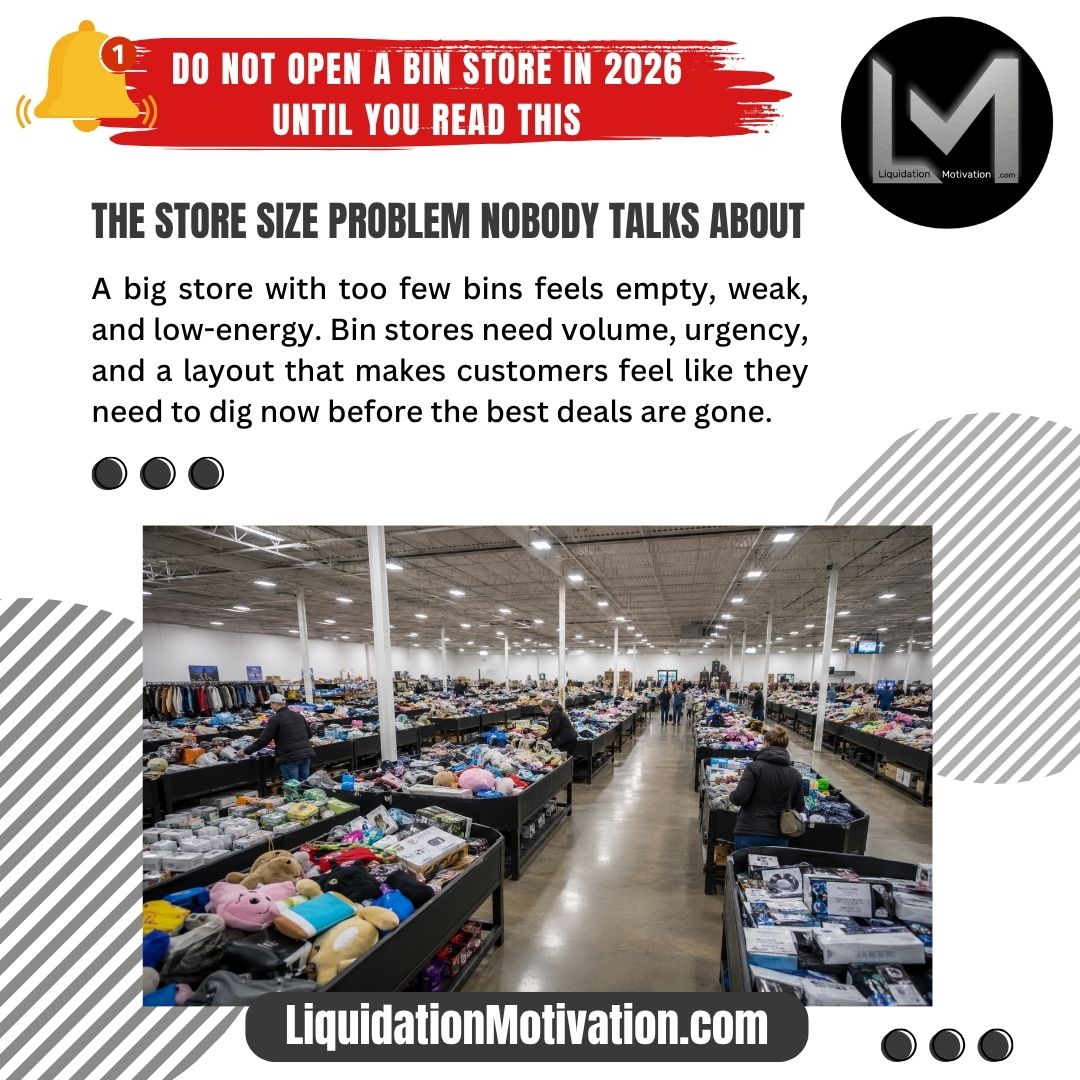
The Store Size Problem Nobody Talks About
Tom talked about walking into a 20,000 square foot bin store with only 20 bins.
Guys, come on.
That store should have had 80 to 100 bins.
You cannot rent a massive space and then barely fill it.
That is how customers walk in and immediately feel like something is off.
Empty space kills energy.
Spread-out bins kill urgency.
Weak volume kills repeat traffic.
A bin store has to feel full.
It has to feel alive.
It has to feel like people better dig now or somebody else is going to find the deal first.
That means your layout, your bin count, your restock plan, and your pricing schedule all have to work together.
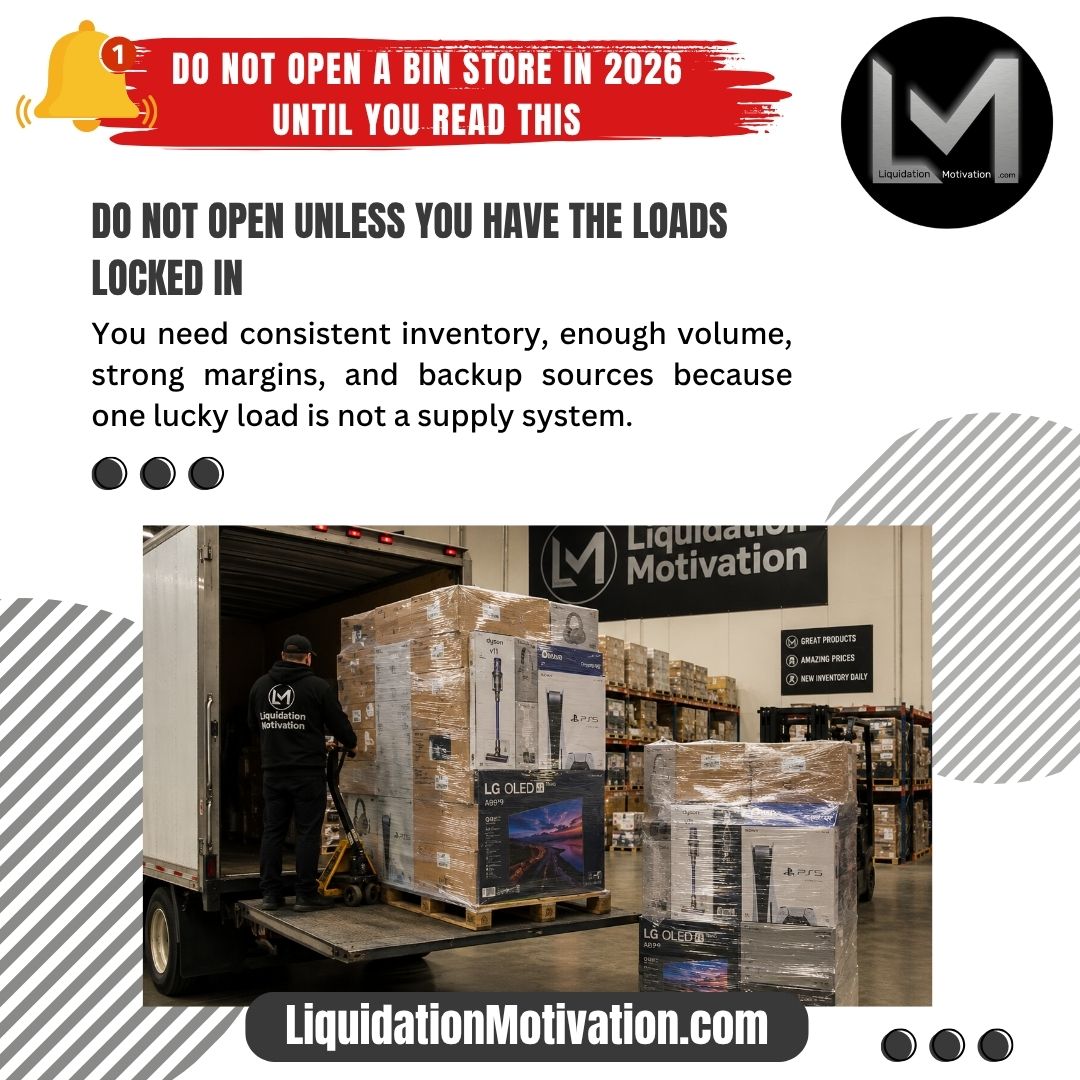
Do Not Open Unless You Have the Loads Locked In
Here is the real rule.
Do not open a bin store in 2026 unless you already know where the loads are coming from.
Not “I found a vendor.”
Not “I know a guy.”
Not “I bought one good pallet once.”
I mean locked in.
Consistent.
Repeatable.
Enough volume to feed the store every week.
Enough margin to survive bad loads.
Enough backup sources to avoid the scramble game.
Because the liquidation business is a roller coaster.
Loads dry up.
Vendors disappear.
Prices move.
Quality changes.
Amazon FC gets tight.
LPN vanishes.
Food-heavy loads show up.
Electronics get repetitive.
And the people who survive are not the people who got lucky once.
They are the people who built a supply system.
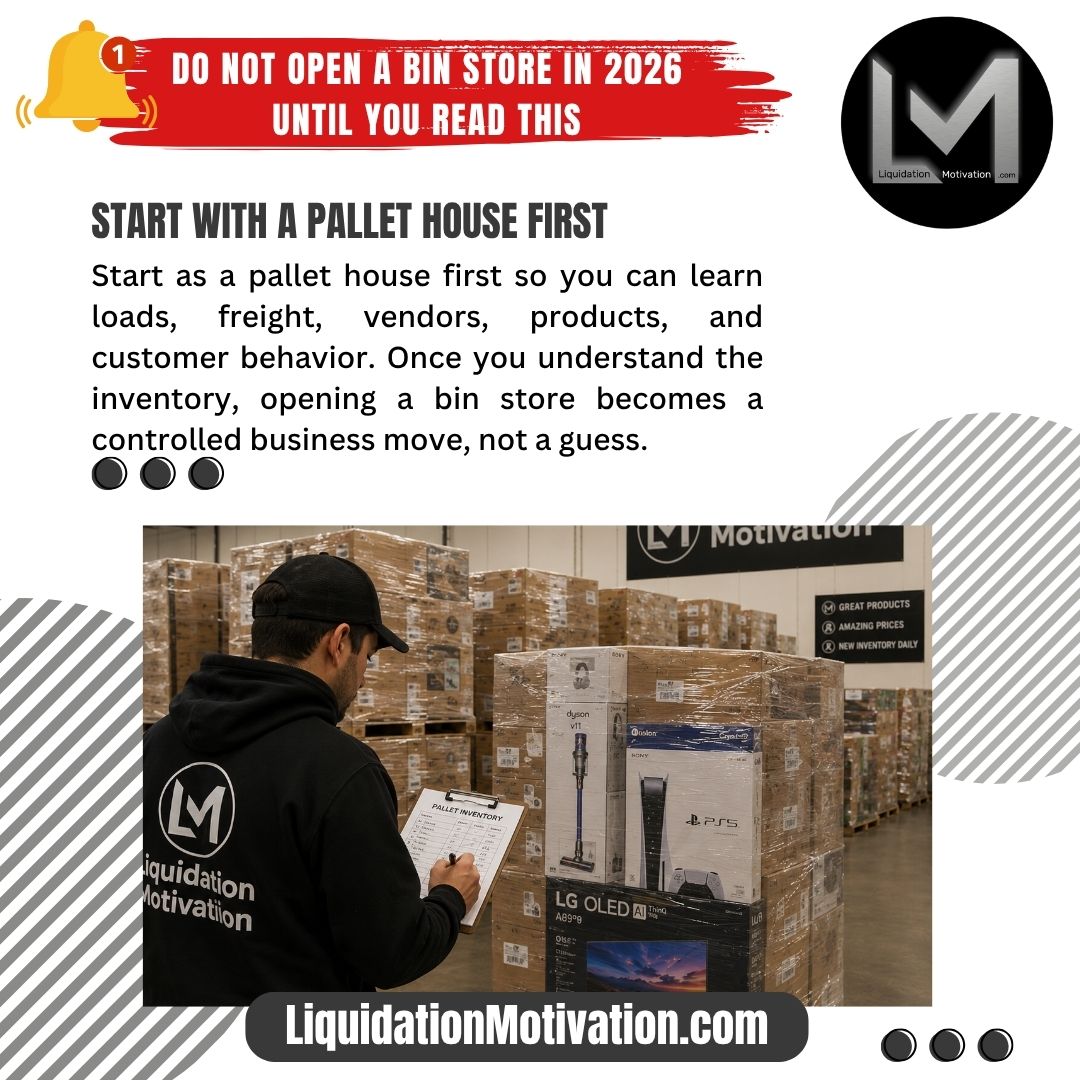
Start With a Pallet House First
If you are new, here is the better move.
Start as a pallet house.
Buy truckloads.
Learn freight.
Learn manifests.
Learn unit counts.
Learn what sells.
Learn what sits.
Learn how customers behave.
Learn what vendors are real and what vendors are just moving problems.
Then, when you understand the product from the outside in, open the bin store.
Now you have control.
Now you can take a full truckload, pull the best mix for the bins, sell pallets on the side, and keep product moving.
That is a business.
That is not guessing.
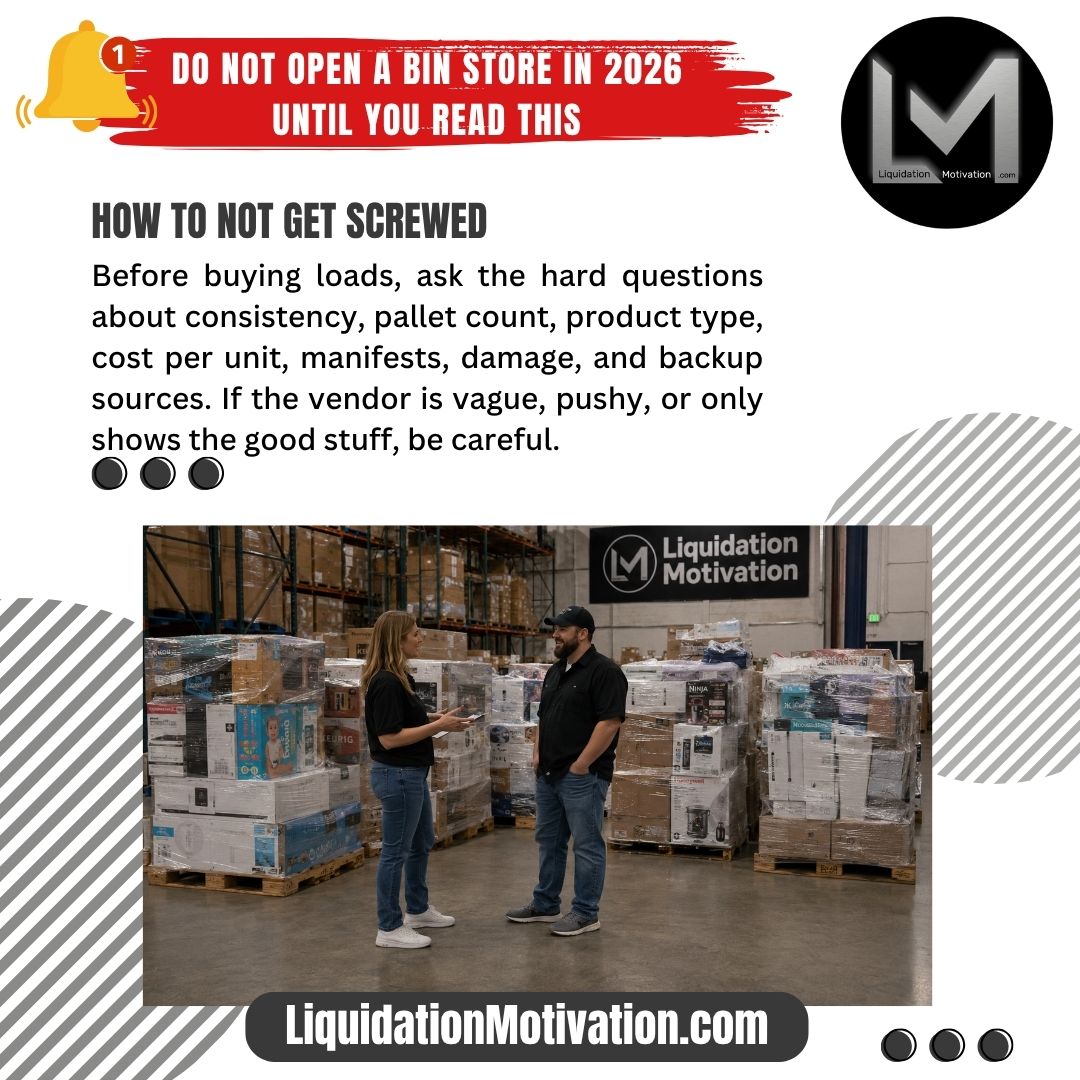
How to Not Get Screwed
Before you open, ask vendors these questions:
Can I get this load every week?
How many pallets are available consistently?
Is it FC, LPN, electronics, returns, shelf pulls, 3PL, unclaimed mail, or mixed?
What is the average cost per unit?
Is there a manifest?
What percentage is food, damaged, outdated, or unsellable?
Can I buy full truckloads?
What happens when this source dries up?
If they cannot answer clearly, be careful.
If every load is “amazing,” be careful.
If they only show you the top layer, be careful.
If they pressure you before you understand the math, be careful.
This business rewards operators.
It punishes dreamers.
How to Price and Rotate Inventory
Keep it simple.
Use a strong price ladder.
Start high enough to capture premium value.
Drop fast enough to move volume.
Do not fall in love with inventory.
A simple ladder can look like:
$12 day
$10 day
$7 day
$5 day
$3 day
$1 day
50¢ day
Then reset.
The goal is not to prove every item is worth more.
The goal is to move the product, create repeat traffic, and keep your bins fresh.
Volume over value.
That is the mantra.
The Final Warning
Do not open a bin store just because you like the concept.
Do not open because your town “needs one.”
Do not open because you found cheap rent.
Do not open because you saw somebody else doing it.
Open because you have the loads.
Open because you know your numbers.
Open because you can fill your freaking bins.
Open because you can avoid the scramble game.
And if you cannot do that yet?
Start with pallets.
Build relationships.
Learn the freight.
Learn the buyers.
Learn the math.
Then step into the bin store game when you are actually ready.
Because I’m tired of seeing people close down stores.
This business can make money.
But only if you respect the supply chain.
Only if you stay hunting.
Only if you save your damn money and stop pretending one good load means you have a business.
Want more real liquidation advice from operators who are actually in the warehouse, buying loads, filling bins, and taking the hits?
Go to www.LiquidationMotivation.com and keep learning before you spend the money.
Now go out there and make some money.
