Amazon and Walmart Pallets, Inventory Risk and Theft
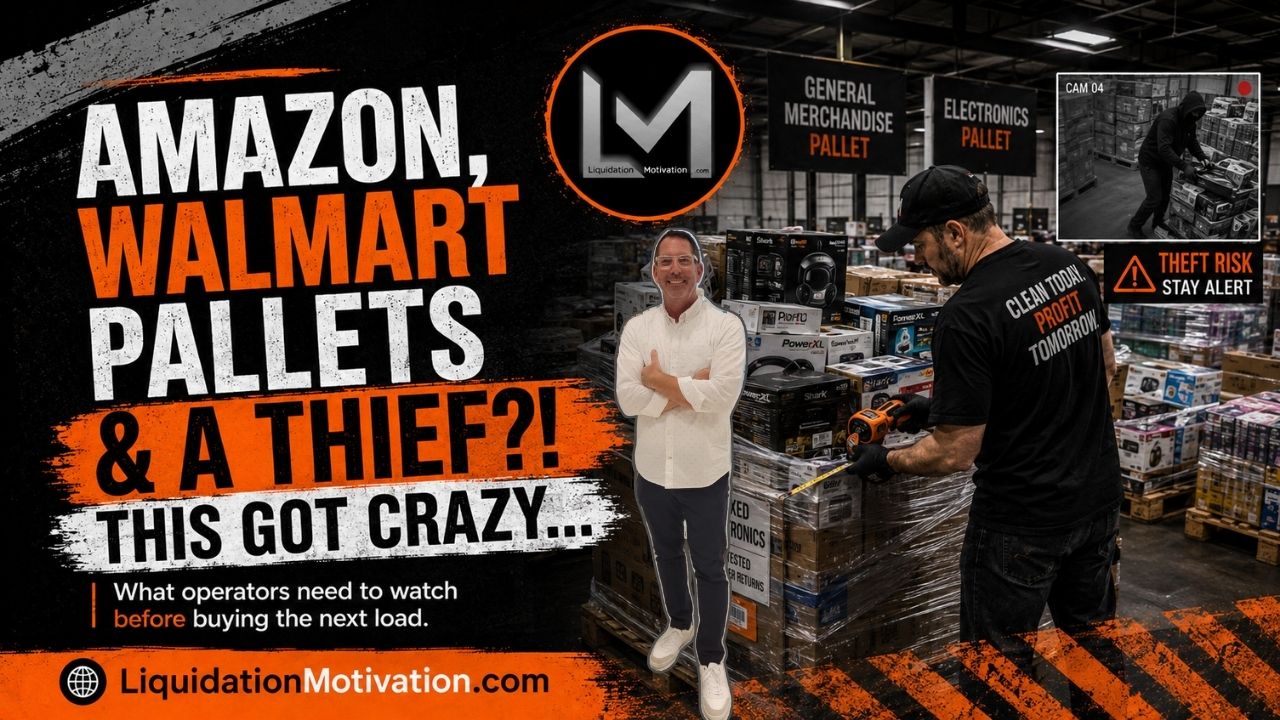
Amazon, Walmart Pallets & a Thief?! This Got Crazy...
I paid more than $30,000 for a 60-pallet Walmart load. One pallet had only 163 items, which put my cost at a little over $3 per piece. Then a buyer took expensive electronics from a $2,000 pallet, stuffed them into a $350 pallet, paid for the cheaper one, and walked out.
Guys, inventory is finally getting easier to find, but that does not mean the problems are over.
More merchandise creates opportunity. It also creates more buying risk, more labor, more storage problems, and more chances for somebody to take advantage of a sloppy operation.

Sixty Pallets Does Not Mean Sixty Good Pallets
The Walmart load was advertised as high piece count. The merchandise itself was not terrible. It was new product from Walmart case packs: electric toothbrushes, lunch boxes, teeth-whitening products, fishing lures, dog cages, and other general merchandise.
The issue was how much product was actually on each pallet.
I expected pallets closer to four feet tall. Some measured only around 30 inches, and the merchandise did not always reach the top. In certain areas, I was looking at roughly two feet of usable product.
That changes the entire deal.
A large dog cage may sell for $12 in a bin store, but it takes up the space of several smaller products. Ten smaller items surviving until the $5 day could produce $50 from the same amount of bin space.
The cage may have a higher retail price, but the smaller merchandise can create better recovery.
Do not judge a truck by the number of pallets. Ask for pallet dimensions, current photos, estimated piece count, packaging details, and the amount of oversized merchandise. A broker saying “60 pallets” does not tell you whether those pallets are full.

Calculate the Cost of Usable Inventory
At approximately $500 per pallet and 163 pieces on one pallet, the cost came to a little over $3 per item.
That is before unloading, sorting, opening cases, cleaning up packaging, moving the merchandise to the store, and dealing with whatever survives the full price ladder.
Comparable LPN inventory may cost closer to $2.50 per piece and offer a stronger mix. That does not automatically make every LPN load better, but it gives you a benchmark.
The question is not whether the truck has good-looking merchandise.
The question is whether your store can recover enough money from it.
Track the real piece count. Track which pricing days produce the sales. Track how much product reaches the final day. Include labor, damage, unsold goods, and fees when evaluating recovery.
If the numbers do not work, do not keep buying because the vendor has a good reputation or because your bins are empty. Avoid the scramble game. Panic buying turns a supply problem into a cash problem.

Packaging Can Kill Your Margin
Another load had around 30,000 items, but the products arrived individually wrapped and packed inside case boxes.
That sounds manageable until your employees have to open every case.
I estimated it could take about 20 labor hours just to remove the merchandise from the packaging before it was ready for the bins. Leaving everything wrapped would create piles of cardboard, paper, and plastic on the sales floor as customers opened the cases.
Cheap inventory is not cheap when your team spends days preparing it.
Ask how the merchandise is packed before buying. Confirm whether it arrives loose, individually bagged, in master cases, or mixed. Find out whether your crew can dump the pallet directly into the bins or whether every item needs to be touched.
Fill your freaking bins, but do it with inventory your employees can process and your customers can shop.

Good Inventory Still Needs the Right Channel
Some of the electronics loads were much better for the bin-store model. They included fans, toys, waffle makers, drones, string lights, smoke alarms, massagers, and other mixed products.
That variety keeps customers digging.
Other merchandise needs a different plan.
I had roughly 200 hoverboards that still needed to be checked. I also received e-bikes with bad batteries. An e-bike may be worth around $300, but a replacement battery can cost about $150. At that point, I have to decide whether to repair it or sell it as-is to somebody who understands the problem.
The same rule applies to seasonal goods.
I still had a truckload of heaters sitting in Florida during hot weather. Some infrared wall heaters may retail for $300 or $400, but nobody wants them when everybody is shopping for air conditioners.
Holding them until colder weather could produce another $20,000 or $30,000 from the load, but they take up warehouse space until then.
Before buying, decide where the product belongs. Some items should go into the bins. Stronger products may belong online or in an auction. Bulky products can sell locally. Seasonal merchandise may need to be stored and wholesaled later.
Volume over value only works when you know how the volume will move.

Pallet Houses Need Better Security
The craziest part of this whole situation had nothing to do with a bad load.
A buyer came into the warehouse late on a Friday when most employees had already left. He removed high-end merchandise from a $2,000 Amazon electronics pallet and hid it inside a $350 Lowe’s pallet.
Then I sold him the cheaper pallet.
The security footage showed him digging through the expensive pallet, moving products, and stuffing them into the pallet he planned to buy. Some of those items later appeared on Facebook Marketplace.
This was not a customer making a mistake. He knew exactly what he was doing.
Pallet sellers need clear controls. Customers should not be left alone around open inventory. High-value pallets need restricted access. Late arrivals should not wander through the warehouse without an employee present. Cameras must cover the buying area, loading area, and high-value merchandise.
The incident also exposed another problem: unmanifested inventory is difficult to document after a theft. The police needed an itemized list and values, but truckload buyers often do not know every item inside a pallet.
Photograph high-value pallets before customers inspect them. Save receiving videos. Document recognizable products. Keep payment records and buyer information.
And make the sales policy clear: all pallets are sold as is, with no refunds, returns, or exchanges. That protects the business from arguments about normal liquidation risk. It does not give somebody permission to move merchandise between pallets before paying.
Save Inventory Before Opening Another Store
The good news is that inventory was finally coming back.
I had 52 electronics pallets waiting to be processed, more than 100 pallets of clothing, over 150,000 clothing pieces, Walmart merchandise, Amazon FC inventory, diapers, dishware, and other mixed pallets.
After months of fighting for inventory, that feels like relief.
But I am also thinking about December. When inventory tightens again, I do not want empty warehouses and weak restock days. Putting away two, four, or even ten dependable truckloads could protect the stores during the next shortage.
Save your damn money and build reserve inventory when supply is strong.
We are also building 72 bins for a store in Georgia. By making the legs removable, we can fit around 72 bins in a tractor-trailer instead of roughly 16 fully assembled bins.
That solves the shipping problem. It does not solve the inventory problem.
Building another store is easier than feeding it every week. Expansion should happen after you have recurring supply, enough working capital, processing capacity, and reserve inventory.
Inventory is back, but operators still have to buy carefully, process efficiently, protect the warehouse, and keep enough merchandise ready for the next shortage.
For more practical liquidation buying and sourcing strategies, visit LiquidationMotivation.com and get the Sourcing Guide.
Now go out there and make some money.
