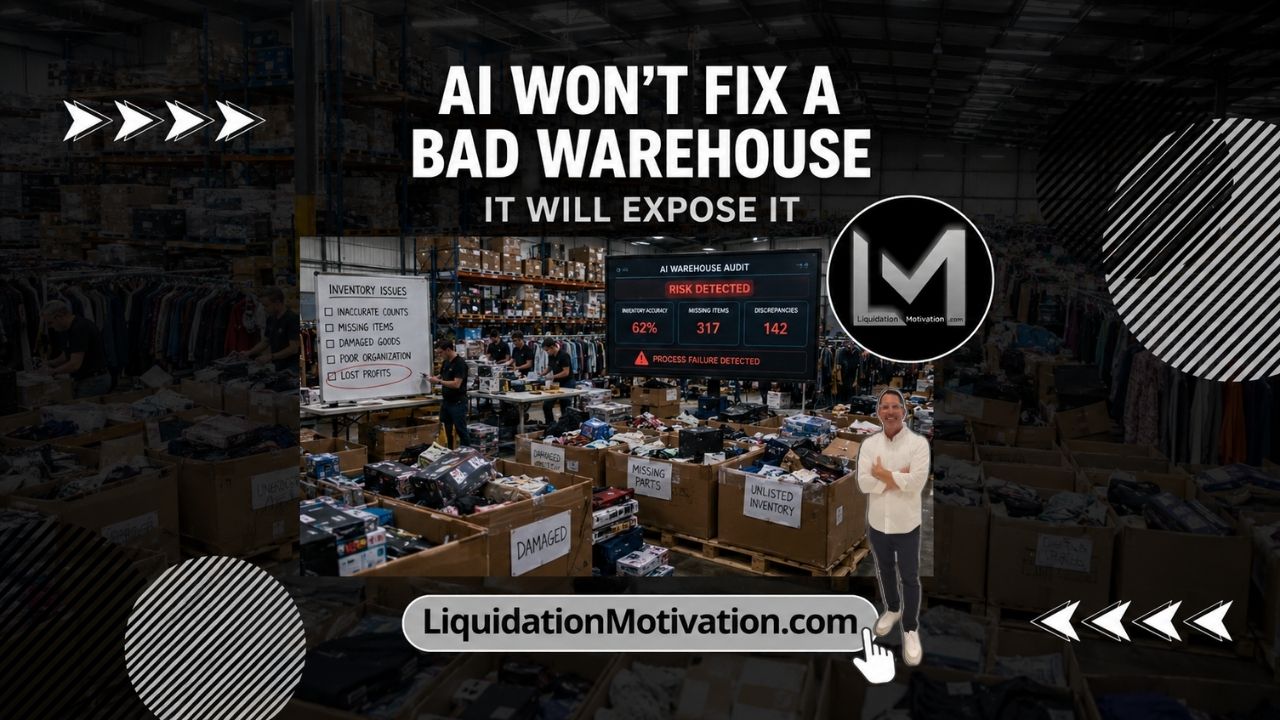
AI in Liquidation Business: Stop Warehouse Inventory Loss
Expensive product was sitting in the garbage. Not broken junk. Not cardboard. Actual sellable product. The only reason anybody found it was because one of the tall 7-foot pallets fell over while Samuel was trying to load it.
Guys, that should make every warehouse owner stop what they are doing.
Tom is talking about the top 10 ways AI can change your business, and this is exactly where the conversation needs to start. Not with cute social media posts. Not with some fancy chatbot on your website. Start with the places where your business is leaking money.
Because if product can make it into the garbage without anybody catching it, you do not just have a trash problem. You have a process problem.

The Garbage Tells the Truth
A warehouse garbage area will show you how disciplined your operation really is.
If sellable inventory is ending up there, something is wrong before it ever reaches the dumpster. Somebody made a bad decision. Somebody skipped a step. Somebody did not understand the value. Or somebody knew exactly what they were doing and hoped nobody would notice.
That is why this situation matters.
The guy taking out the garbage was not the problem. He was the one reporting it. He was digging through the trash to make sure actual trash was leaving the building. That tells me the business had at least one person paying attention, but the system still had a hole in it.
You cannot build a real liquidation operation on luck.
If the pallet had not fallen over, that product may have left the building. Gone. Paid for, handled, moved, and then thrown away.
That is the kind of mistake that eats margin quietly.

Cameras Are Not a System
They said it should all be on video.
Good.
But let’s be honest. Most warehouse owners only check cameras after something goes wrong. That means the camera is not preventing anything. It is just helping you investigate after the money is already at risk.
That is where AI can actually help.
AI can help review video faster. It can help flag activity around garbage areas, doors, cages, receiving lanes, and pallets. It can help managers narrow down who touched the product, when it moved, and whether it went through the right process.
That does not mean you let a machine run your warehouse.
It means you stop expecting one manager to remember everything, watch everything, and catch every bad move in real time.
A camera system without review is just expensive decoration. A camera system tied to a clear process becomes accountability.

AI Should Follow the Product Flow
A liquidation business is messy by nature.
You are dealing with returns, shelf pulls, damaged boxes, incomplete items, oversized goods, mixed pallets, and employees making judgment calls all day. Some product goes to bins. Some goes online. Some goes to auction. Some gets bundled. Some gets recycled. Some is real trash.
The danger is when employees decide that on their own with no clear rules.
That is where money disappears.
AI in a liquidation business should be built around the product flow. From receiving to sorting to pricing to selling to disposal, every step should have a rule. If the rule is unclear, the product should go to review, not the garbage.
Use AI to build sorting guides. Use it to create checklists by category. Use it to train new employees on what counts as trash and what needs a second look. Feed it examples from your own warehouse so the answers match your operation.
A tool that helps employees decide where product goes can save more money than another motivational post online.
LLMs Are Problem Solvers, Not Magic
Tom mentioned LLMs. That means large language models.
Most people hear that and think it is just something that writes emails. That is a small use.
An LLM can read instructions, organize messy information, compare situations, summarize reports, and help solve repeated problems. Tom said this type of technology goes back about 20 years in simpler forms, when people were using it for games and testing how machines could think.
Now it can help business owners make faster decisions.
But only if you give it a real problem.
“Help me make content” is fine.
“Help me stop employees from throwing away sellable inventory” is better.
That is operator thinking.

Build a Trash Review Process
Every warehouse needs a trash policy that is simple enough for employees to follow.
Not a 50-page manual nobody reads.
A practical system.
Anything clearly unsafe, leaking, contaminated, broken beyond use, or true waste can go out. Anything with possible resale value should go to a review area before it hits the garbage. That review area might be a cart, a pallet, a cage, or a marked section near the manager’s station.
The point is simple: employees should not be making final disposal decisions on valuable product without oversight.
Once that system exists, AI can support it.
Create a simple internal assistant with your warehouse rules. Let employees ask, “Where does this go?” Build category examples for electronics, tools, clothing, small appliances, home goods, and incomplete items. Add photos if needed. Update it when mistakes happen.
Every incident should improve the system.
If expensive product ended up in the garbage once, the question is not just who did it. The question is how the process allowed it.

Fire Fast, But Fix the Hole
Tom said to find out who did it and fire him immediately.
I get it.
When somebody throws expensive product in the garbage, that is not a tiny warehouse mistake. That is either careless, lazy, or dishonest. None of those belong in an operation that runs on tight margins.
But firing one person does not fix the whole issue.
You still need to know whether the problem happened before. You need to know whether other employees are unclear on trash rules. You need to know whether the same category keeps getting dumped because nobody knows how to sell it.
That is where AI can help with incident tracking.
Log every issue. What product was found? Where was it found? Who handled it? What shift was working? Was the item damaged, incomplete, or sellable? What rule should have stopped it?
Over time, that creates a real management tool.
Not emotion. Not guessing. Facts.
Use AI Where the Money Leaks
A lot of operators want to use AI where it looks cool.
Do not start there.
Start where it protects cash.
In liquidation, that may mean video review, sorting rules, employee training, trash control, auction descriptions, online listing drafts, customer service, vendor notes, and pricing support.
The best AI setup is not the flashiest one. It is the one that saves labor, catches mistakes, and helps product move to the right channel.
Volume over value still matters, but volume only works when your process can handle it. If your warehouse is moving fast and product is getting misclassified, you are not scaling. You are bleeding.
That is why the warehouse floor matters more than the buzzwords.
AI will not save a sloppy operation.
It will expose it.
If your garbage area is loose, tighten it. If your cameras are only checked after problems happen, improve the review process. If your employees do not know what to throw away, give them clear rules. If expensive product can disappear because a pallet did not fall over, you are relying on luck.
That is not a business plan.
Use AI like an operator. Point it at the real problems. Protect the inventory you already paid for. Save your damn money before you go chasing the next shiny tool.
Learn more at www.LiquidationMotivation.com.
